


Lease vs Finance in Kingston: Which One Actually Suits You?

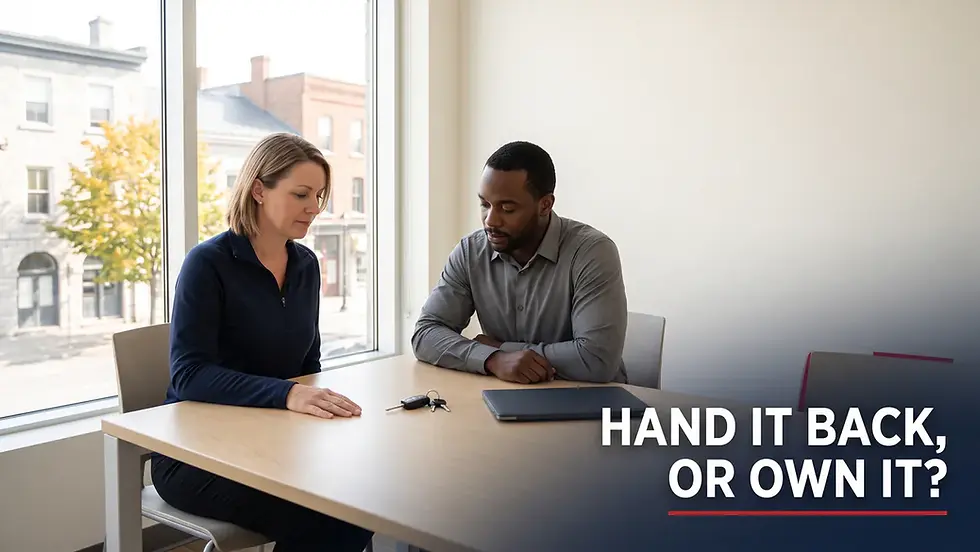
Answer one question honestly and this decision is mostly made: do you want to own the vehicle at the end, or would you rather hand it back and start again?
Financing buys the vehicle over time, and when the payments stop it is yours. Leasing pays for a set period of use, and at the end you hand it back, buy it out, or start another one.
So the lease vs finance question is not really a money question at all. It is a question about what you want to be true in a few years, and about what you are willing to be obliged to in the meantime.
Jim Thompson Chrysler is a Chrysler, Dodge, Jeep and Ram store on Gardiners Road, and both paths are available here, O.A.C.
This guide explains the structure of each one and leaves the numbers where they belong: on a specific vehicle, in writing, in front of you.
Key Takeaways
Financing ends with you owning the vehicle. Leasing ends with a hand-back, a buy-out, or another lease, and almost every other difference between the two follows from that one.
A lease sets a distance limit and a condition standard, because somebody has to sell that vehicle afterwards. A loan sets neither, because the vehicle is already yours.
Ontario protects lease customers specifically. The Government of Ontario's "Buying a new or used vehicle: your rights" page, read September 29, 2026, states that before you enter into a lease agreement or make any payments, the business offering the lease must provide you with a written statement covering the length of the term, the amount, timing and number of payments, a description of the leased goods, the implicit finance charge, the total lease cost and the annual percentage rate.
Because motor vehicle contracts in Ontario have no cooling-off period, take the time to read the agreement and ask questions before signing — according to the Government of Ontario's "Buying a new or used vehicle: your rights" page, read September 29, 2026.
Jim Thompson Chrysler in Kingston will set the lease structure and the finance structure side by side on the same vehicle before you choose anything, and both are available through our online credit application, O.A.C.
Lease vs Finance: Which One Should You Choose?
Finance if you want to own the vehicle at the end. Lease if you would rather pay for a fixed number of years of use and hand the vehicle back.
That really is the whole decision in two sentences, and everything below is the detail that makes it real rather than theoretical.
Two smaller questions settle almost all of the rest.
How far do you actually drive?
A lease agreement sets a distance limit and charges you for the distance you cover beyond it, at a rate written into your own agreement. A loan has no such limit, because nobody has to resell the vehicle at the end except you.
How long do you keep a vehicle?
If your honest answer is "until it owes me nothing", financing suits you and leasing does not. If it is "a few years, then something newer", a lease is built for exactly that.
Anyone who tells you one of these is simply better than the other has skipped both questions.
Lease vs Finance in Real Life: Which Kingston Week Looks Like Yours?
Most people recognize themselves in about thirty seconds when the two are described as weeks rather than as contracts.
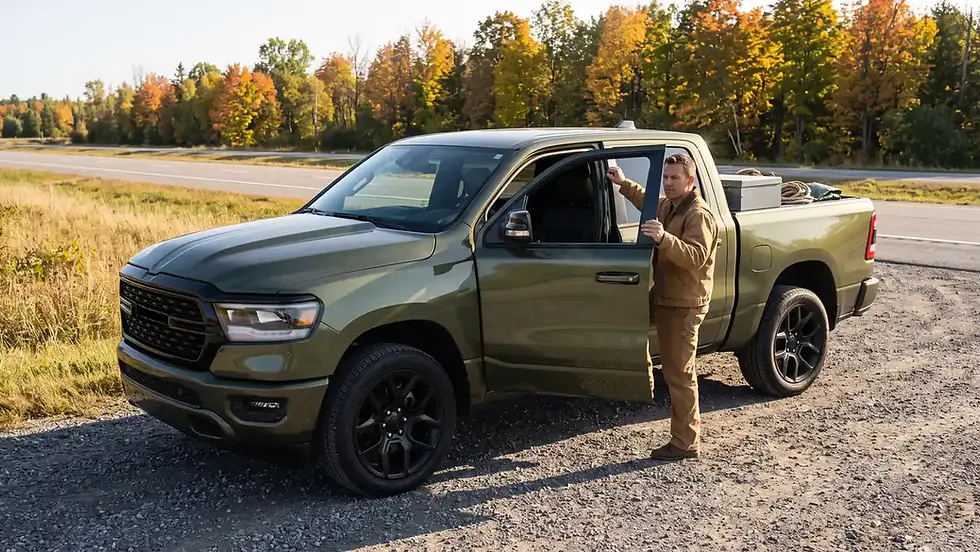
The first week belongs on a loan. You are on Highway 401 before it is properly light, out to Belleville on Monday and Gananoque on Thursday, and there is a toolbox bolted into the back that is not coming out for anybody.
The vehicle takes gravel, salt, a trailer and a dog, and it is not going to look showroom-fresh in three years because it is working for a living.
You have kept every vehicle you have owned until it owed you nothing, and the best thing about the last one was the stretch of years after the payments ended.
That person should own the vehicle, and a loan is how you get there.
The second week belongs on a lease. The vehicle does Gardiners Road, the school run, the Cataraqui Centre and a clean highway trip once in a while, and it sleeps in a garage.
You are not sentimental about it. You want to know what the next few years look like, and you would rather be in something newer when this term is up than in something that is starting to need things.
Maybe it also carries your business name on the side, and predictability matters to you more than owning an asset that depreciates.
That person should lease, and there is nothing unsophisticated about it.
Neither of those two people is being smarter than the other. They want different things at the end, and the contract should match.
If the first week is yours, our Ram 1500 buyer's guide is a useful next read, and if the second week is yours with a family in it, our Dodge Durango guide covers that side of the lineup.
Lease vs Finance, Side by Side: What Actually Differs?
Here is the whole comparison in one place, with no numbers in it, because the numbers belong to a specific vehicle and a specific agreement rather than to an article.
What you are agreeing to | On a lease | On a loan (financing) |
|---|---|---|
Who owns it at the end | The lessor does, unless you exercise a buy-out written into the agreement | You do, outright, once the last payment clears |
How far you can drive | A distance limit is set in the agreement, with a charge for distance beyond it | No limit; distance only affects what the vehicle is worth later |
Condition at the end | You return it to a condition standard set out in the agreement, and you can be charged for damage beyond it | Your problem and nobody else's; wear costs you at resale, not in a bill |
Modifications and accessories | Usually have to come off, and the vehicle has to be returned as agreed | Yours to make and yours to live with |
Who carries the vehicle's future value | The lessor, in a closed-end lease. In a residual obligation lease you may owe an amount at the end | You do, entirely, for as long as you own it |
Getting out early | Commonly two routes: settle what the agreement says you owe, or transfer the remaining term if your agreement allows it. Both have a cost set in the agreement | There is a route out, and it usually means selling or trading and settling the balance |
What the next trade-in looks like | Return it, buy it out, or review its payoff and trade value — the route depends on your agreement and lender | You bring an asset, and what it is worth against the balance is the whole conversation |
Read that column by column and you will notice something. A lease puts kilometer and return-condition obligations in writing at the outset. With financing, your payment obligation is also written up front; the variable is the vehicle’s value when you later sell or trade it.
Neither is hidden. They are simply on different schedules.
One thing this article deliberately does not carry is current offers, because they change. When you want to see what is actually running right now, that lives on our new car deals page.
What Are You Signing Up For, and Who Owns It at the End?
Everything a lease asks of you exists for one reason: somebody has to sell that vehicle after you are finished with it.
Kilometer limits, measured against a real Kingston commute
A distance limit is a promise about how much of the vehicle's life you intend to use, and you should test it against your actual year before you sign anything.
Drive the 401 east to the 416 and into Ottawa and back several days a week and you are covering a serious distance annually, and that is the single most common reason a lease turns out to be the wrong contract for a Kingston driver.
Do a west-end loop, a school run and the occasional trip to Toronto and you are nowhere near the same territory.
Work it out honestly on the drives you actually made last year, not the ones you meant to make. Your service records or your last oil change sticker will tell you more than your memory will.
Wear and tear after a Kingston winter
A lease agreement sets out the condition the vehicle has to come back in, and Eastern Ontario is harder on that clause than most places in the country.
Salt, sand, plough spray and a winter of gravel on Highway 401 do real work on rocker panels, wheels, glass and paint, and a leased vehicle has to be handed back to somebody who will resell it.
None of that is an argument against leasing. It is an argument for keeping the vehicle protected, washing the underside through the winter, and reading your own agreement's condition wording before the last month rather than during it.
If you are not sure what condition your tires or your paint are actually in, bring it to our service department and we will measure the tread and look it over honestly, whether the vehicle is leased, financed or yours outright.
What happens if you need out early
Both contracts have a way out, and both of them cost something, so the question is never "can I" but "what does it cost me and what am I left with".
Getting out of a lease early usually means settling what the agreement says you owe, because you promised a term of use and you are ending it, and some agreements allow the remaining term to be transferred to another person, which your own agreement will say. The routes and their costs are written in that agreement, and that is the page to read before you sign it, not after.
Getting out of a loan early usually means selling or trading the vehicle and settling the balance with your lender. If the vehicle is worth more than the balance, the difference is yours; if it is worth less, the difference has to be dealt with.
There is one Ontario protection worth knowing on the financing side. The Government of Ontario's "Buying a new or used vehicle: your rights" page, read September 29, 2026, states that once you have paid off two-thirds or more of your payment obligation under a car-financing agreement with a car dealer or a third-party financer, no one can seize or resell the car unless they have an order from the Ontario Superior Court of Justice.
Who owns it at the end, and what that does to your next trade-in
At lease end, your options may include returning the vehicle, buying it out, or reviewing its payoff and trade value. The available route depends on your agreement and lender.
At the end of a loan you own an asset. It may not be worth a fortune, but it is yours, and it is what you put toward whatever comes next.
That is also the honest version of the thing nobody says out loud: if you sell or trade before a loan is finished and the vehicle is worth less than the balance, the difference does not disappear, it moves to the next deal.
That is the real long-game difference between the two, and it is the part most comparisons skip. A lease keeps your obligations short and your options open; ownership builds something you can hand over the desk next time.
Either way, find out what your current vehicle is worth before you shop, not after. See what your current vehicle is worth online, then let us appraise it in person and put the number in writing.
We also buy vehicles outright, so a vehicle you own can be sold to us even if you are not buying anything from us that day.

What Does Ontario Require Before You Sign a Lease?
Ontario treats a consumer lease as its own kind of agreement with its own disclosure rules, and that is genuinely useful to you.
Which leases Ontario protects
The Government of Ontario's "Buying a new or used vehicle: your rights" page, read September 29, 2026, states that three types of lease are protected under the Consumer Protection Act: a lease for four months or more, a lease that continues indefinitely or renews automatically, and a residual obligation lease.
The Government of Ontario's vehicle-buying rights page defines a residual obligation lease as a type of lease where you may be required to pay an amount to the lessor at the end of the term, and states that the Act sets out rules on calculating the maximum amount you can pay on that type of lease.
So the first thing to establish about any lease in front of you is which of those it is, and what the agreement says you could owe at the end.
What has to be in writing before you sign
Per the Government of Ontario's vehicle-buying rights page, before you enter into a lease agreement or make any payments, the business offering the lease must give you a written statement, and it has to set out six things:
the length of the lease term
the amount, timing and number of payments to be made
a fair and accurate description of the leased goods
the implicit finance charge
the total lease cost
the annual percentage rate
Read that statement while you are sitting down, and ask about anything you cannot explain back in your own words. A good finance office would rather answer it twice than have you sign something you do not follow.
The two rules that catch people out
According to the Government of Ontario's vehicle-buying rights page, under Ontario law there is no cooling-off period for motor vehicle contracts, so be sure of your decision before you sign.
That is the one nobody enjoys hearing, and it is the reason all of the reading happens before the signature rather than after it.
The same Government of Ontario page states that advertisements by vehicle dealers must show an all-inclusive price, so that the only additional amount you pay is tax. That rule applies to every registered dealer in the province, ours included.
Source, last verified September 29, 2026: the Government of Ontario's "Buying a new or used vehicle: your rights" page page, which carries its own last-updated date of March 12, 2026. Nothing about Ontario law in this article is stated from anywhere else.
Who Should Not Lease, and Who Should Not Finance?
Three kinds of buyer get the wrong answer here, and it costs us nothing to say so plainly.
Do not lease if what you want is a paid-off vehicle and no payment at the end. A lease is built to end and begin again, so if the years after the last payment are the part you are looking forward to, finance it and keep it.
Do not lease if you drive far more than a limit would allow. Distance beyond the limit is charged at a rate set in the agreement, and a long daily commute is the most expensive way to find that out.
Do not lease if the vehicle is going to be worked hard. Ladders, gravel, trailers and job sites are ownership territory, not hand-back territory.
Do not finance a vehicle you already know you will be tired of before it is paid off. Wanting something newer every few years is a perfectly reasonable thing to want, and a lease is the contract shaped for it.
And if what you actually want is to own something outright without a long obligation at all, buying a good used vehicle is a third answer that neither side of this debate mentions. Our used Ram truck guide is a decent place to start reading, and our used inventory is where the current listings sit.

Financing and Leasing at Jim Thompson Chrysler in Kingston (O.A.C.)
Both are available here on new vehicles, and financing is available on pre-owned vehicles as well, O.A.C.
What we do differently is simple enough to describe in one sentence: we will put both structures on the same vehicle, on one page, at the same desk in our building at 805 Gardiners Road, before you are asked to choose.
That page carries the appraisal on your current vehicle, the payout request to your lender if there is still a loan on it, and both sets of paperwork side by side. Nothing is on a separate sheet in somebody's drawer.
Send an online credit application before you come in if you want the finance side moving first. It takes a few minutes, it is not binding, and it commits you to nothing at all, O.A.C.
Credit histories differ, and ours is not the desk where that becomes a conversation you dread. Send the application, tell us the situation in your own words, and we will tell you plainly what the options are, O.A.C.
Nobody here will promise you an outcome before seeing an application, because that promise is not ours to make.
If you would rather start with the department page than with an application, our finance department is where the process is laid out.
And bring your trade into the conversation early rather than late. See what your current vehicle is worth online first, then we appraise it in person, any make, paid off or not.
Why Bring Your Lease vs Finance Decision to Jim Thompson Chrysler?
Because the structure question, the trade, the payout on your current loan and the application all get answered in one building on Gardiners Road, by people who will tell you when a lease is the wrong contract for your year.
With a large selection of new Chrysler, Dodge, Jeep and Ram vehicles in stock, Jim Thompson Chrysler carries new Chrysler, Dodge, Jeep and Ram vehicles, with current availability available online or from our team.
What that looks like in practice:
We will tell you to finance rather than lease if your year on the road is longer than a limit would comfortably allow.
We appraise your current vehicle in person, whatever make it is and whether or not it is paid off, and put the number in writing.
Build and price the vehicle you are considering the way you want it, then bring what you configured to our sales team and we will structure it both ways.
Send a credit application online so the finance side is already moving before you visit, O.A.C.
Ask us to read your existing lease or loan agreement with you, including the part about getting out early, before you commit to anything new.

Frequently Asked Questions
Is it better to lease or finance a vehicle in Canada?
Neither is better in general, and anyone who says otherwise has skipped the question that decides it. Financing ends with you owning the vehicle outright, and leasing ends with a hand-back, a buy-out or another lease.
Choose on three things: whether you want to own it at the end, how far you actually drive, and how long you keep a vehicle.
What happens if I go over the kilometer limit on a lease?
You pay for the distance you cover beyond the limit, at a rate written into your own lease agreement rather than a rate that is the same everywhere.
Work out your real annual distance before you sign, not afterwards. If your year is long, financing is usually the contract that suits you, and we will say so.
Can I get out of a lease or a car loan early?
Yes, both have a route out, and both cost something set in your own agreement rather than in an article. On a lease you settle what the agreement says you owe for ending early.
On a loan you usually sell or trade the vehicle and settle the balance with your lender, and what it is worth that day decides the rest.
What does Ontario require a lease agreement to tell me?
The Government of Ontario's "Buying a new or used vehicle: your rights" page, read September 29, 2026, says that before you enter a lease or make any payments, the business must give you a written statement.
It sets out the term, the payments, a description of the goods, the implicit finance charge, the total lease cost and the annual percentage rate.
Can I trade in my current vehicle when I lease or finance at Jim Thompson Chrysler?
Yes. See what your vehicle is worth online, then Jim Thompson Chrysler on Gardiners Road in Kingston appraises it in person and puts the value in writing, any make, paid off or not.
Lease and finance options are available through our online credit application, O.A.C., and the application is not binding.
Find Your Lease vs Finance Answer in Kingston
Settle the ownership question first and the rest of this gets simple: decide whether you want the vehicle at the end, then let the contract follow the answer.
See what your current vehicle is worth, then send our quick online credit application so the finance side is moving before you arrive, O.A.C.
Browse the new inventory or the used listings, and bring the vehicle you are interested in to us with the question still open.
Then ask our team to write it both ways on that vehicle, and pick the one that matches the answer you already gave about the end.
Come and see us on Gardiners Road, just off Highway 401, whether you are coming from downtown, the west end, Amherstview, Odessa, Napanee, Gananoque or off the Wolfe Island ferry.
Visit us at 805 Gardiners Road, Kingston, ON K7M 7E6
Browse inventory online, value your trade, get pre-approved on approved credit, book service, or contact our team.
Local: (613)-389-4426 Sales: (877)-251-9249 Parts: (888)-711-5309 Service: (888)-713-0742
About the Author:
Kerry Irven is the Vice President of New and Used Automotive Operations for Heighton Automotive Group, a family-owned and operated automotive group serving communities across Eastern Ontario. Kerry began his automotive career in new-car sales, building his experience on the showroom floor and working his way through multi-store dealership operations.
With over 25 years in the automotive industry, Kerry has helped grow automotive businesses from one location with 40 to 50 vehicles in stock to more than 500 vehicles across 10 rooftops. His hands-on background in both new and used-vehicle operations gives him a practical understanding of what customers look for when shopping for their next vehicle.
Throughout his career, Kerry has always been actively involved in staff coaching and in understanding customer wants and needs, helping ensure the businesses he works with continue to adapt to what customers are truly looking for.
One of the most exciting chapters of his career has been the shift into modern automotive marketing, embracing new technology, transparent pricing, customer-first inventory strategies, and new ways to create a better vehicle-shopping experience.
Kerry has completed extensive automotive training, including certification through the Ontario Motor Vehicle Industry Council, involvement with the Used Car Dealers Association of Ontario, Canadian automotive dealer training, and multiple customer service courses.
Born and raised on a farm, Kerry has always valued family, hard work, and a practical, down-to-earth approach. Joining Heighton Automotive Group and working alongside Thomas Heighton and family, along with managing partners Kyle Lothian and Martin Gougeon, has allowed him to bring those same values into the car business. It has also allowed Kerry to continue following a simple philosophy: treat every customer exactly the way he would want to be treated.

Comments