


Traction Control Light: When It Flashes and When It Stays On


A traction control light on a 2026 Ram 1500, Jeep Grand Cherokee or Chrysler Pacifica has two meanings in those models' owner's manuals: flashing, the system is working while the tires are slipping; staying on, the system has found a fault. The light also comes on for a moment each time the vehicle is switched on, and a separate ESC OFF light, named for Electronic Stability Control (ESC), shows that the system is in a reduced mode.
For a Kingston driver, a flash on a slippery start is the system doing its job, and a light that stays on is one for our service team at Jim Thompson Chrysler.
Owners of a different model or model year should go by that vehicle's own manual: this guide rests on three 2026 owner's manuals, and Transport Canada's page "Electronic stability control" tells drivers to check their own owner's manual for how their vehicle's system works. Anyone after a button sequence for switching stability control off, or a way to clear the light, will find the modes described as the manuals print them, with no steps.
Key Takeaways
A flashing traction control light means the stability system is at work as the tires begin to slip, or that the Traction Control System (TCS) is active, according to the 2026 Ram 1500, Jeep Grand Cherokee and Chrysler Pacifica owner's manuals.
A traction control light that stays on means a malfunction in the Electronic Stability Control (ESC) system, the 2026 Ram 1500, Jeep Grand Cherokee and Chrysler Pacifica owner's manuals say, and if it is still lit after several ignition cycles and several kilometers of driving at more than 48 km/h (30 mph), they call for service as soon as possible.
When the light flashes during acceleration, the 2026 Ram 1500, Jeep Grand Cherokee and Chrysler Pacifica owner's manuals tell drivers to lift off the accelerator, use as little throttle as they can and match their speed to the road conditions.
Electronic Stability Control (ESC) cannot overrule the laws of physics or add grip the road does not offer, say the 2026 Ram 1500, Jeep Grand Cherokee and Chrysler Pacifica owner's manuals, and Transport Canada adds that worn-out, under-inflated or overloaded tires leave it able to do little and that drivers also need winter tires.
Electronic Stability Control (ESC) is on again every time the vehicle starts, according to the 2026 Ram 1500, Jeep Grand Cherokee and Chrysler Pacifica owner's manuals, and both the ESC indicator and the ESC OFF light come on for a moment at each start; at other times, the ESC OFF light marks a reduced mode.
What a Flashing or Steady Traction Control Light Means
If the traction control light stays on after several ignition cycles and the vehicle has been driven several kilometers above 48 km/h (30 mph), the 2026 Ram 1500, Jeep Grand Cherokee and Chrysler Pacifica owner's manuals call for the Electronic Stability Control (ESC) system to be serviced as soon as possible. Jim Thompson Chrysler in Kingston reads it this way: a light that flashes and goes out once the tires grip is the system at work, and a light still on after those drives is one for our service team to look at.
The traction control light people search for is the light the manuals call the ESC Activation/Malfunction Indicator Light, and it also flashes while the Traction Control System (TCS) is active.
In the 2026 Ram 1500, Jeep Grand Cherokee and Chrysler Pacifica owner's manuals, the light "starts to flash as soon as the tires lose traction" and the stability system comes into play. CAA-Quebec's guide "Understand 14 important warning lights in your car" says a flashing light shows the system "actively correcting a loss of grip."
A light that comes on continuously while the vehicle is on is another matter: the manuals say it means "a malfunction has been detected in the ESC system."
Transport Canada's page says ESC has been mandatory on cars, SUVs, pickups and minivans from the 2012 model year.
Jim Thompson Chrysler's service department works out of our Service Centre on Gardiners Road.
Traction Control Light On: Kingston's Slippery Days and Your Tires
With the traction control light on and flashing as you pull away on a slippery Kingston street, the 2026 Ram 1500, Jeep Grand Cherokee and Chrysler Pacifica owner's manuals give one instruction for a light that begins flashing during acceleration: "ease up on the accelerator and apply as little throttle as possible." Those manuals also ask drivers to suit their speed and driving style to the road they are on.
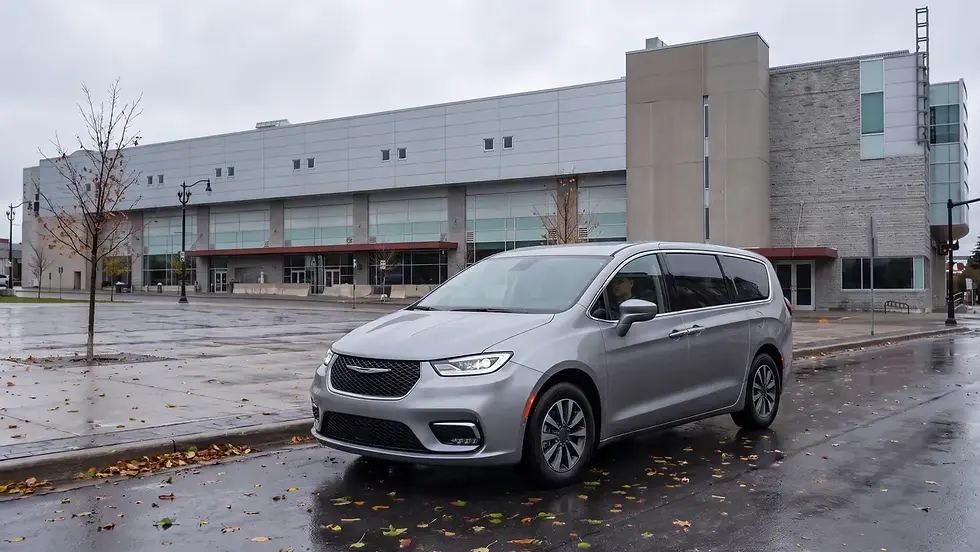
Transport Canada's page is blunt about the limit: "This technology does not and cannot change the laws of physics." The three manuals likewise say ESC cannot prevent physics acting on the vehicle, and that it cannot add traction beyond what the road surface allows.
The system works by braking one or more wheels for a moment, cutting engine power, or both, to hold the vehicle on the path the driver intended, Transport Canada explains.
Tire condition counts as well: the 2026 Ram 1500 owner's manual warns that "Improperly inflated and unevenly worn tires may also degrade ESC performance." Transport Canada adds that tires which are overloaded, under-inflated or worn out leave even the best ESC system able to do little.
Transport Canada follows that tire advice with a short line: "You also need winter tires".
Choosing the week for winter tires is simpler once you know the reading on a Kingston thermometer that says it is time for them.
A Light That Stayed On Along Woodbine Road
Over a few days of ordinary errands, you notice the traction control light in your Pacifica is staying on, not flashing, including on the run along Woodbine Road at normal speed.
That evening you send the Request Service form and name the traction control light in its message box.
Your Pacifica is in front of our service team before the season's first heavy snow, instead of carrying that light through the whole winter.
Why Is My Traction Control Light On, or Is It the ESC Off Light?
A traction control light that is on without flashing is either the brief check at every start or, if it stays lit while the vehicle is on, the steady fault described in What a Flashing or Steady Traction Control Light Means, according to the 2026 Ram 1500, Jeep Grand Cherokee and Chrysler Pacifica owner's manuals. The ESC OFF light is a different light, and it means Electronic Stability Control (ESC) is in a reduced mode.
Both lights come on for a moment each time the vehicle is switched on, and the Grand Cherokee and Pacifica manuals add that the traction control light should go out once the engine is running.
The 2026 Ram 1500 and Jeep Grand Cherokee owner's manuals say the ESC OFF light shows that the driver "has elected to have the Electronic Stability Control (ESC) in a reduced mode." The 2026 Chrysler Pacifica owner's manual says the light means ESC is in a reduced mode.
The Ram 1500 manual's warning-light chapter states it directly: "This warning light indicates the ESC is off."
An ABS light or a brake warning light is its own warning, and you can read what an ABS light or a red brake warning light means before deciding on a next step.
Deep Snow and the Reduced Stability Control Modes
In deep snow, a reduced stability control mode may help a stuck vehicle get moving where its owner's manual offers one for that purpose, and Transport Canada's page notes that some vehicles have a manual ESC Off switch for situations "such as when you are stuck in snow".
In the 2026 Jeep Grand Cherokee and Chrysler Pacifica owner's manuals, Partial Off comes with one line of purpose: "This mode may be useful if the vehicle becomes stuck." Those two manuals explain that Partial Off allows the wheels to spin more than the system normally permits.
The Pacifica manual adds a note for "starting off in deep snow, sand, or gravel": extra wheel spin may help there, and the manual has the driver turn ESC back on once the situation is over.
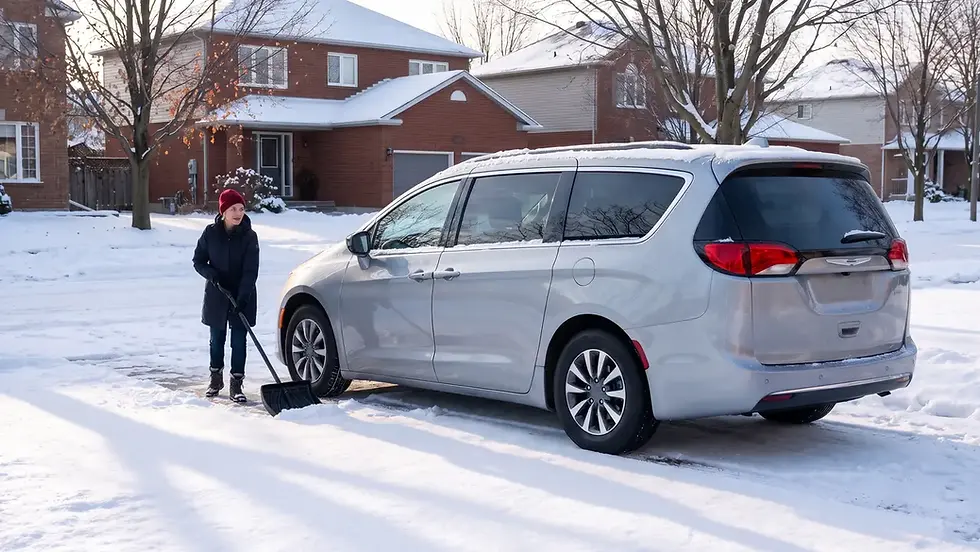
The 2026 Ram 1500 owner's manual lists a Full Off mode that "is intended for off-highway or off-road use only." That manual also warns: "With the ESC switched off, the enhanced vehicle stability offered by ESC is unavailable."
Whatever mode was chosen, the 2026 Ram 1500, Jeep Grand Cherokee and Chrysler Pacifica owner's manuals say that at each start "the ESC system will be on even if it was turned off previously." Transport Canada's page likewise has ESC switched on every time you start the vehicle.
Which of these modes your own vehicle has depends on the model, so check with our service team if you are unsure.
Starting With the No-Wrench Vehicle Inspection for a Steady Light
A traction control light that stays on is one of the warning lights our No-Wrench Vehicle Inspection page says "can be initially investigated without mechanical disassembly". Our service team is glad to take a look at that steady light on your vehicle.

Until our service team replies, the date you send through Request Service remains the one you would like rather than a fixed appointment.
A Loaner and a Return Trip Through Signature Service
For a steady light on a vehicle that still starts and drives as usual, JTC Signature Service puts you in a loaner, as availability allows, Monday to Friday, while our team runs your vehicle to our service bays and back.

The pick-up and the return both stay within Kingston city limits, and we arrange their times with you by telephone first; contact us for more details.
A vehicle that will not start, or one you are unsure is safe to drive, is one for our Service line, listed with the phone numbers that close this page.
Frequently Asked Questions
Is It Okay to Drive With the Traction Control Light On?
The light's pattern decides it: the 2026 Ram 1500, Jeep Grand Cherokee and Chrysler Pacifica owner's manuals say a flash means the system works and, if it flashes during acceleration, to use less throttle. Those manuals call a steady light a fault for service as soon as possible after several ignition cycles and several kilometers over 48 km/h (30 mph).
What Causes a Traction Control Light to Come On?
Lost traction or an active Traction Control System (TCS) makes the light flash in the 2026 Ram 1500, Jeep Grand Cherokee and Chrysler Pacifica owner's manuals, and a detected malfunction in the Electronic Stability Control (ESC) system keeps it on. Those manuals add a brief glow at every start, and a separate ESC OFF light for a reduced mode.
How Do I Fix the Traction Control Warning Light?
For a steady light, the 2026 Ram 1500, Jeep Grand Cherokee and Chrysler Pacifica owner's manuals give one step: service as soon as possible once it stays on through several ignition cycles and several kilometers driven faster than 48 km/h (30 mph). A light that only flashes needs no fix: those manuals say it flashes while the system works.
Does Traction Control Turn Back On When You Start the Vehicle?
Yes, according to the 2026 Ram 1500, Jeep Grand Cherokee and Chrysler Pacifica owner's manuals: Electronic Stability Control (ESC) is on again at every start, even after being switched off, and Transport Canada's page likewise has ESC switched on with every start. Those manuals describe the ESC OFF light as the sign that ESC is in a reduced mode.
Is a Buzzing or Clicking Sound Normal When Traction Control Works?
Yes, in the 2026 Ram 1500, Jeep Grand Cherokee and Chrysler Pacifica owner's manuals: the Electronic Stability Control (ESC) system "will make buzzing or clicking sounds when it is active", and they call this normal. Those manuals add that the light flashes while the system is active, starting the moment traction is lost.
Stability Control Through the Winter Months
Before winter settles over Kingston, the difference to know is the one the 2026 Ram 1500, Jeep Grand Cherokee and Chrysler Pacifica owner's manuals draw: a traction control light that flashes is the system working, and one still on after several drives is a fault to have serviced as soon as possible.
If the traction control light in your vehicle has stayed on, Request Service with Jim Thompson Chrysler ahead of the snow.
Visit us at 805 Gardiners Road, Kingston, ON K7M 7E6
Request Service to ask for a preferred date and time. A request is not a confirmed appointment until our service team contacts you.
Local: (613)-389-4426 Sales: (877)-251-9249 Parts: (888)-711-5309 Service: (888)-713-0742
About the Author:
Kerry Irven is the Vice President of New and Used Automotive Operations for Heighton Automotive Group, a family-owned and operated automotive group serving communities across Eastern Ontario. Kerry began his automotive career in new-car sales, building his experience on the showroom floor and working his way through multi-store dealership operations.
With over 25 years in the automotive industry, Kerry has helped grow automotive businesses from one location with 40 to 50 vehicles in stock to more than 500 vehicles across 10 rooftops. His hands-on background in both new and used-vehicle operations gives him a practical understanding of what customers look for when shopping for their next vehicle.
Throughout his career, Kerry has always been actively involved in staff coaching and in understanding customer wants and needs, helping ensure the businesses he works with continue to adapt to what customers are truly looking for.
One of the most exciting chapters of his career has been the shift into modern automotive marketing, embracing new technology, transparent pricing, customer-first inventory strategies, and new ways to create a better vehicle-shopping experience.
Kerry has completed extensive automotive training, including certification through the Ontario Motor Vehicle Industry Council, involvement with the Used Car Dealers Association of Ontario, Canadian automotive dealer training, and multiple customer service courses.
Born and raised on a farm, Kerry has always valued family, hard work, and a practical, down-to-earth approach. Joining Heighton Automotive Group and working alongside Thomas Heighton and family, along with managing partners Kyle Lothian and Martin Gougeon, has allowed him to bring those same values into the car business. It has also allowed Kerry to continue following a simple philosophy: treat every customer exactly the way he would want to be treated.


Comments