


How to Sell a Car With a Loan on It in Kingston: The Payout, the Lien and Three Ways to Sell
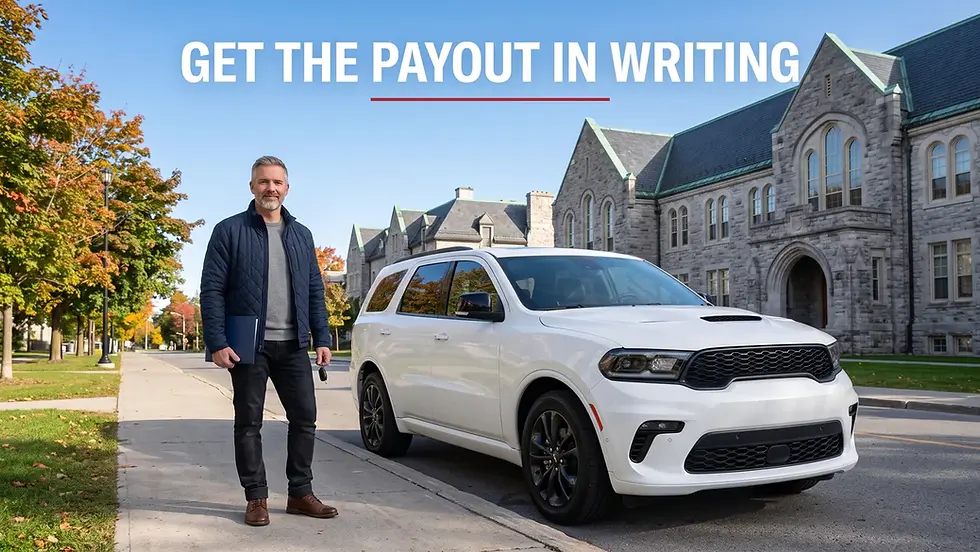
If you are working out how to sell a car with a loan on it, the short answer is yes: a car with a loan on it can be sold or traded, and the loan is paid out as part of the sale.
Ask your lender for a written payout statement first. Whether the car is worth more or less than that payout decides what happens next.
At Jim Thompson Chrysler on Gardiners Road in Kingston, you can use Value My Trade online, bring your trade in for an appraisal, and apply for financing on your next vehicle from home, before you visit, O.A.C. Ask our team how a trade with a loan still on it would be handled, and keep in mind that any approval depends on the review of your application.
The process in this guide is general, and the terms of your own loan are your lender's to explain.
Key Takeaways
Yes, a car with a loan on it can be sold or traded, and the loan is paid out as part of the sale. The first step is a written payout statement from your lender.
What the car is worth against the payout decides the rest. Worth more, and the difference is your equity; worth less, and you have what the Financial Consumer Agency of Canada calls "negative equity", a gap you cover when you sell or that, in a trade, may be added to the amount financed on your next vehicle, O.A.C., increasing the amount borrowed and potentially the total cost of borrowing.
OMVIC's vehicle trade-in page, read October 13, 2026, says OMVIC's Code of Ethics, the Consumer Protection Act and the Sale of Goods Act require dealers to remove liens on trade-ins as soon as possible. Before anyone signs, Jim Thompson Chrysler in Kingston would want your lender's written payout on the desk, and the discharge confirmed in writing once the loan is paid, since the Financial Consumer Agency of Canada says liens stay registered on your car until you've paid your debt in full.
Three ways to sell are covered here: trading it in, selling it outright to a dealership, or selling it privately. A private sale puts the payout timing and the paperwork on you, including the Used Vehicle Information Package, which the Government of Ontario says the seller is legally required under the Highway Traffic Act to provide to the buyer.
Once the payout is in writing, each dealership route has its own page at Jim Thompson Chrysler in Kingston. Use Value My Trade for a trade or We Buy Cars for an outright sale, and apply for financing on your next vehicle from home, O.A.C.; any approval depends on the review of your application.
How to Sell a Car With a Loan on It in Kingston
You get a written payout from your lender, find out what the car is worth, and make sure the sale pays that loan out in full. Selling a car with a loan on it follows that order whether you trade it in, sell it to a dealership or sell it privately:
1. Get your lender's payout on paper. The payout is the amount still owing on the loan, as your lender states it.
2. Find out what the car is worth. Use Value My Trade online, and if you are trading in, bring your trade in for an appraisal on our lot on Gardiners Road.
3. Put the two numbers side by side. A car worth more than the payout leaves you equity, and a car worth less leaves a gap to cover.
4. Choose how to sell. Trade it in toward your next vehicle, sell it outright to a dealership (with us, through We Buy Cars), or sell it privately.
5. Agree how the loan gets paid out. In a private sale, plan for the payout to reach your lender before the ownership changes hands; in a trade or a sale to a dealership, ask before you sign how and when the dealership will pay the loan out.
6. Transfer the ownership. In a private sale the buyer registers the car in their own name, and you keep your licence plates.
7. File the proof. Once the loan is paid in full, the lender releases the lien by registering a discharge, and a letter confirming it belongs with the car's sale papers, so ask for one.
What Does Walking In Ready Look Like?
Walking in ready looks like a Saturday morning when you drive to Gardiners Road with a folder on the passenger seat: your lender's written payout, your ownership permit and the second key. You already know what you owe, and whatever the appraisal comes back at, the choice to trade, to sell outright or to take the car home and sell it privately is still yours.

No number in that folder is a promise about how the sale will turn out. The folder settles the order of things, so each conversation starts from your own figures.
When Should a Kingston Seller Get the Appraisal?
Get the appraisal close to the date on your payout, if your lender ties the payout amount to a date, so the two numbers you compare describe the same week. A payout from one month and an appraisal from another can leave you comparing figures that no longer line up.
If a posting out of CFB Kingston or a move away from Queen's sets your date, ask your lender for the payout early, so the sale is not squeezed into your last week in town.
If you bring your trade in to us for an appraisal, the car is inspected on our lot at 805 Gardiners Road in Kingston's west end.
What Is a Payout Letter, and What Should You Ask Your Lender?
A payout letter, sometimes called a payout statement, is your lender's written figure for what it takes to close the loan on your car, and OMVIC's vehicle trade-in page, read October 13, 2026, describes the loan payout as the amount still owing. Have the lender's payout letter in hand before you price, list or trade the car.
Use the lender's own payout rather than the balance printed on an old statement, because the payout is the number the loan closes on.
Questions to Put to Your Lender
These questions get the lender's side of a car sale on paper:
What is the payout amount, and can you send it to me in writing?
Is that amount tied to a date, and if it is, which date?
Does my loan agreement carry any charge for paying the loan out early?
How do you accept the payout, and can a buyer or a dealership pay it to you directly?
Once the loan is paid, when will you register the discharge of your lien, and will you confirm it to me in writing?
Keep the lender's answers with your ownership permit so they are at hand when you sell.
What Is a Lien, and How Is It Released When You Sell?
A lien on a car with a loan on it is the lender's registered claim, and the Financial Consumer Agency of Canada, read October 13, 2026, says a car lien is a lender's claim for repayment that they register against a car or other type of motor vehicle. The lender releases the lien after the loan is paid, by registering what is called a discharge.
The Financial Consumer Agency of Canada also says liens stay registered on your car until you've paid your debt in full. So the payout is what the release turns on, whichever way you sell.
The Government of Ontario's Access Now page puts a time on the release: when a consumer loan is repaid, the lender is required to register a "discharge" within 30 days. Leave room for that window when you agree a date with a private buyer.

When a Car Carries More Than One Lien
A car can carry more than one lien: the Financial Consumer Agency of Canada says a car may have more than one lien on it, and that garages also have the right to place a lien, called a mechanic's lien. If a repair bill on your car is unpaid, settle it before you sell.
What Do Equity and Negative Equity Mean When You Sell a Car With a Loan?
Equity is the share of the car's value that is yours once the loan is paid: when the car is worth more than the payout, the difference is your equity. Negative equity is the reverse, and the Financial Consumer Agency of Canada, read October 13, 2026, says you have "negative equity" when your car is worth less than the amount you owe on your car loan.
When the Car Is Worth More Than the Payout
When your car is worth more than the loan payout, the difference is your equity, and it is yours once the lender has been paid. In a private sale or an outright sale to a dealership the equity comes to you, and in a trade, ask how your equity will be applied to the next vehicle before you sign.
When the Payout Is the Bigger Number
When the payout on your car is higher than what the car is worth, you are in negative equity, and the part of the loan the sale does not cover is still owed to your lender. Sell in that position, and you might have to borrow money to cover the difference, according to the Financial Consumer Agency of Canada's page on the financial risks of buying a car.
The Financial Consumer Agency of Canada adds that you may also end up paying more if you trade in your car to buy another one, and that you may need to borrow to pay for the new car and cover the amount you still owe. With a trade-in, that difference may be added to the amount financed on your next vehicle, O.A.C., increasing the amount borrowed and potentially the total cost of borrowing.
Among its ways of reducing the risks of auto financing, the Financial Consumer Agency of Canada lists "avoid trading in your car if you're in negative equity", advice that holds for a trade with us as much as anywhere else.
Other ways through the gap are to cover it from savings when you sell, or to keep the car longer and keep paying the loan down before you sell.
If a trade still suits you, use Value My Trade online, bring your lender's written payout, and apply for financing before you visit, O.A.C.
Selling a Car With a Loan: Trade-In, Dealership Sale or Private Sale?
Selling a car with a loan works three ways: trade it in toward your next vehicle, sell it outright to a dealership, or sell it privately. In each, the loan is paid out before the lien comes off; what changes is how much of the work, the paperwork and the timing falls on you.
Trading It In
Trading in a car with a loan on it means the car goes to the dealership as part of buying your next vehicle, with the loan settled in the same deal. OMVIC's vehicle trade-in page says trading in a vehicle versus selling privately has pros and cons.
OMVIC's trade-in page says "On the downside, dealers generally offer the wholesale value of a trade-in, which could be less than what an individual may get selling privately."
OMVIC puts the upside this way: "trading in a vehicle is easier, faster and more secure; it avoids the potential headaches (for example, no-shows, ownership transfer, obtaining secure payment) associated with selling privately; and, there are tax savings to be had when trading in." In OMVIC's example of those tax savings, the buyer pays HST only on the cash difference between the vehicle being bought and the trade-in.
Selling privately means handling the no-shows, the ownership transfer and the job of obtaining secure payment yourself, which OMVIC names as the potential headaches a trade avoids.
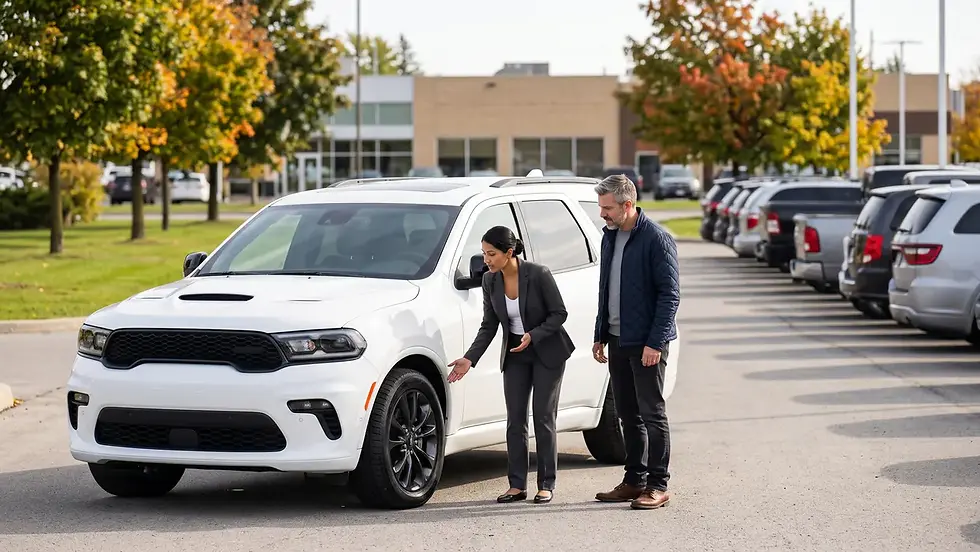
With Jim Thompson Chrysler, use Value My Trade online, then bring your trade in for an appraisal on our lot and ask how a trade with a loan on it would be handled. We work to get the maximum value for your trade.
Selling It Outright to a Dealership
Selling outright means a dealership buys your car and you do not buy anything in return, so the sale money goes toward the payout and any equity left over is yours. If the payout is higher than the sale price, the difference is yours to cover before the lien comes off.
Use We Buy Cars for an outright sale with us, and ask our team, before you visit, what happens with a vehicle that still has a loan on it.
Selling It Privately in Ontario
A private sale of a car with a loan on it puts more of the work on you than a trade does: the buyer's money, your lender's payout and the ownership transfer happen in an order you arrange yourself. In return, the asking price is yours to set.
The Government of Ontario's page on buying or selling a used vehicle says that before you sell a used vehicle, you need to:
buy a Used Vehicle Information Package (UVIP)
make sure that the Vehicle Identification Number (VIN) on your vehicle matches the number on your permit
check to ensure the vehicle has no money owing on it
With a loan on the car, the no-money-owing check is the step to plan around: agree with your buyer, in writing, how the payout reaches your lender and when the ownership changes hands. Ask your lender how it accepts a payout sent by someone else, so the buyer's money goes where it should.
Expect a careful buyer to ask for proof, since the Financial Consumer Agency of Canada tells buyers of a car with a lien on it to make sure the seller removes it, including by getting proof in writing that the current car owner has paid off the debt and removed the lien.
In a private sale, the Used Vehicle Information Package is yours to supply: the Government of Ontario says that as the seller you are legally required under the Highway Traffic Act to provide the buyer with a UVIP. Checking the lien information is one of the sections in our Used Vehicle Information Package guide.
You keep your licence plates, which the Government of Ontario's buy or sell page says travel with a driver, not a vehicle.
Before you list a car that shows a warning light or needs attention, send our service team a request through the service appointment page, and the team can tell you what it finds.
What a Dealership Can and Cannot Do About Your Loan
A dealership that takes a car with a loan on it in trade works under a written lien rule, and no dealership can make the lien go away before your loan is paid in full. OMVIC's vehicle trade-in page includes these points for anyone trading in a vehicle, with us or with any dealership:
OMVIC's Code of Ethics, the Consumer Protection Act and the Sale of Goods Act require dealers to remove liens on trade-ins as soon as possible.
Dealers are required by law to ask an individual trading in a vehicle to sign a trade-in disclosure document outlining important information about the previous use, history and condition of the trade (for example, previous accidents), as the dealer is legally required to give full disclosure to anyone they then sell the vehicle to.
If a dealer offers to make the monthly loan payments on a trade-in, rather than pay off the loan in full, you should understand this is a significant risk and contact OMVIC at once.
If a payment for a vehicle you traded in is deducted from your bank account, contact the dealer and the financial institution, and if that doesn't rectify the problem, contact OMVIC's Complaints & Inquiries Department immediately.
Ask any dealership, us included, how and when your loan will be paid out before you sign.
Financing on your next vehicle is a separate decision again: you can apply for financing online, O.A.C., and any approval depends on the review of your application.
Which Sellers Should Read Another Guide or See a Lawyer?
Sellers with a leased car, a loan someone else wants to take over, a separation or an estate behind the sale, or worries about their credit history should read another of our guides or see a lawyer. The guide fits if you own a car with a loan on it and want to sell it or trade it.
If the car is leased, you have a lease rather than a loan, and the way out is set by the lease agreement; our guide to leasing versus financing covers what happens if you need out early.
Handing the loan to someone else, rather than selling them the car, has its own routes, set out with the Ontario paperwork in our car loan transfer guide.
When a separation or an estate is behind the sale, speak with a lawyer before the lender or any buyer.
If your credit history is what worries you about the next vehicle, our guide to bad credit car loans explains what lenders look at, and you can apply for financing online, O.A.C.
How Do You Apply for Financing on the Car You Buy Next?
You apply for financing online, from home, before you visit, O.A.C., and any approval depends on the review of your application. Financing is available on the vehicles we sell, O.A.C.
Tell our team that the car you drive now has a loan on it, use Value My Trade for that car, and bring the lender's written payout when you come in.

For the next car, you can browse our list of current new models, and our new inventory and our used inventory show what is currently available.
Why Sell or Trade at Jim Thompson Chrysler When Your Car Still Has a Loan on It?
Because each dealership route in this guide has its own page on our site: Value My Trade for a trade-in, We Buy Cars for an outright sale, and the 30 Second Credit Application for your next vehicle, O.A.C. Jim Thompson Chrysler, at 805 Gardiners Road in Kingston, sells new Chrysler, Dodge, Jeep and Ram vehicles and used vehicles of other makes.
Bring your trade in for an appraisal on our lot, with your ownership permit and your lender's written payout, and ask our team how a vehicle with a loan on it would be handled before you decide anything.
Frequently Asked Questions
Can I Sell My Car With a Loan on It?
Yes, a car with a loan on it can be sold or traded, and the loan is paid out as part of the sale, since the Financial Consumer Agency of Canada, read October 13, 2026, says liens stay registered on your car until you've paid your debt in full. Ask your lender for a written payout statement first.
What Is a Payout Letter on a Car Loan?
A payout letter is your lender's written statement of what it takes to close your car loan, and OMVIC's vehicle trade-in page, read October 13, 2026, describes the loan payout as the amount still owing. Ask your lender whether the payout amount is tied to a date, and keep the letter with your ownership permit.
How Soon Does a Car Lien Come Off in Ontario After the Payout?
Your lender takes the lien off by registering a discharge, and the Government of Ontario's Access Now page, read October 13, 2026, gives the timing: when a consumer loan is repaid, the lender is required to register a "discharge" within 30 days. Build that window into the date you agree with a private buyer.
What If My Car Is Worth Less Than the Payout?
A payout above the car's value is negative equity, which the Financial Consumer Agency of Canada describes as a car worth less than the amount you owe on your car loan. In a trade, the gap may be added to the amount financed on your next vehicle, O.A.C., increasing the amount borrowed and potentially the total cost of borrowing.
How Do I Trade or Sell a Financed Car at Jim Thompson Chrysler in Kingston?
Get your lender's written payout first, then use Value My Trade for a trade-in or We Buy Cars for an outright sale, and bring the car to 805 Gardiners Road in Kingston for an appraisal. Ask our team how a car with a loan on it would be handled, and apply for financing on your next vehicle online, O.A.C.
Find Your Way to Sell a Car With a Loan on It in Kingston
One phone call to your lender for the written payout settles the first question, and the trade-in, the outright sale to a dealership or the private sale comes after that, with the choice yours. Whichever you pick, the loan is paid out before the lien comes off.
For a trade, use Value My Trade; for an outright sale, use We Buy Cars; and for the next vehicle, apply for financing online, O.A.C., with any approval depending on the review of your application.
Then bring the folder to 805 Gardiners Road in Kingston's west end for a conversation with our team.
Visit us at 805 Gardiners Road, Kingston, ON K7M 7E6
Browse inventory online, value your trade, apply for credit approval, O.A.C., book service, or contact our team.
Local: (613)-389-4426 Sales: (877)-251-9249 Parts: (888)-711-5309 Service: (888)-713-0742
About the Author:
Kerry Irven is the Vice President of New and Used Automotive Operations for Heighton Automotive Group, a family-owned and operated automotive group serving communities across Eastern Ontario. Kerry began his automotive career in new-car sales, building his experience on the showroom floor and working his way through multi-store dealership operations.
With over 25 years in the automotive industry, Kerry has helped grow automotive businesses from one location with 40 to 50 vehicles in stock to more than 500 vehicles across 10 rooftops. His hands-on background in both new and used-vehicle operations gives him a practical understanding of what customers look for when shopping for their next vehicle.
Throughout his career, Kerry has always been actively involved in staff coaching and in understanding customer wants and needs, helping ensure the businesses he works with continue to adapt to what customers are truly looking for.
One of the most exciting chapters of his career has been the shift into modern automotive marketing, embracing new technology, transparent pricing, customer-first inventory strategies, and new ways to create a better vehicle-shopping experience.
Kerry has completed extensive automotive training, including certification through the Ontario Motor Vehicle Industry Council, involvement with the Used Car Dealers Association of Ontario, Canadian automotive dealer training, and multiple customer service courses.
Born and raised on a farm, Kerry has always valued family, hard work, and a practical, down-to-earth approach. Joining Heighton Automotive Group and working alongside Thomas Heighton and family, along with managing partners Kyle Lothian and Martin Gougeon, has allowed him to bring those same values into the car business. It has also allowed Kerry to continue following a simple philosophy: treat every customer exactly the way he would want to be treated.

Comments